
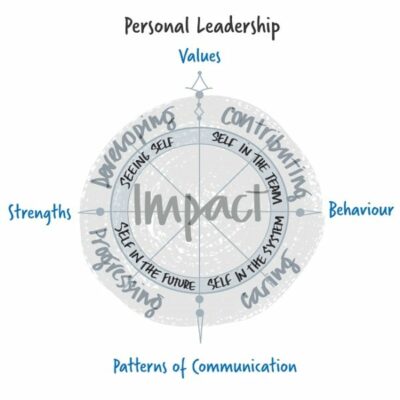
Listen to Fiona MacNeill speaking about the concept of Personal Leadership.
The personal leadership work to be completed in this programme is an opportunity to orientate yourself inside your leadership thinking.
Leadership is historically judged on actions taken. In large organisational systems, this is often influenced by the expectations of others, perceived norms and boundaries, and a culture of obedience.
This leads to the idea that where a few people are doing all of the thinking, most people are not. Without intention, this creates a culture of learned helplessness where thinking is not valued as much as action.
What typifies a focus on Personal Leadership?
- Putting people before process; no point in sacrificing results for efficiency.
- Ensuring that your behaviour is aligned to your values, your body shows when it’s not, and leaders need to be authentic.
- Recognising that the work of leadership is an extended conversation with colleagues, service users/customers, partners, and the unknown future.
- Creating the conditions for ourselves and others to have meaningful conversations.
- Saying the things that can’t be said for the sake of the future, not our ego.
- Understanding what your role is in creating the current culture, leaders get what they tolerate and that there is so much more available.
- Extending to others what we want them to model: it begins with us.
- Providing unfiltered appreciation and praise: creating belonging.
A recent academic article described Personal Leadership as follows:
‘Personal leadership encompasses the personal behaviour of leaders in performing the responsibilities of professional leadership, including expertise, trust, caring, sharing and morals. People must have confidence in the expertise of their leaders and must trust that the leaders are doing what is best for everyone. Leaders must also demonstrate that they care about people, must share authority and information with people, and must act in a moral way. Engaging in these behaviours has been shown to contribute to effective personal leadership. The current research suggests that personal leadership will motivate individuals to willingly contribute their efforts towards organisational success.
And from a more pragmatic stance, albeit coming to the same conclusions, watch this ‘Nutshell’ video about Brene Brown’s book Dare to Lead.
Taking the time to really focus on the components of your Personal Leadership will help you to align and hold yourself differently as you navigate the complexities and joys of your leadership journey.