
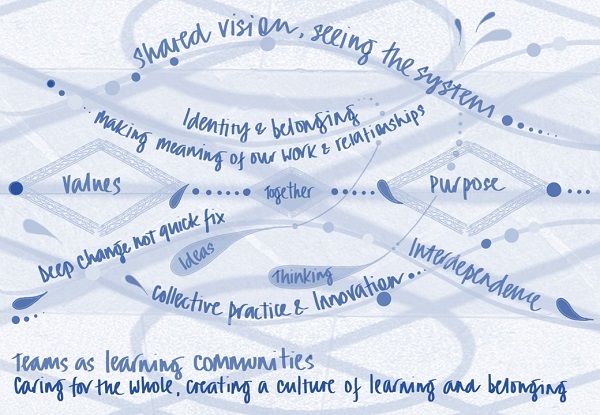
The thinking behind Appreciative Teams that function as Communities of Practice is simple; the people are the organisation. How you engage and enthral them will, as we have already seen, have a direct impact on many important factors, which in turn impact on the team and its sense of purpose and well-being.
Processes don’t do work, people do. Look closely at the inner workings of any organisation and you’ll discover gaps between official work processes – the “ideal” flows of tasks and procedures, and the real-world practices behind how things actually get done. The real genius of teams that work in the community is the informal, impromptu, often inspired ways that real people solve real problems in ways that formal processes can’t anticipate. When you’re competing on knowledge and service, improvisation, innovation and sharing of learning matters just as much as standardisation.
What really motivates people in my team?
In his book, “Drive,” Daniel Pink proposes a new motivational model that he believes is a better fit for today’s creative and innovative workplaces.
Pink’s model focuses on enabling people to become intrinsically motivated – that is, using internal drivers for motivation. He calls this behaviour “Type I.” It contrasts with the traditional model of extrinsic motivation, or “Type X” behaviour, which focuses on motivating people through reward and punishment.
To build an intrinsically motivated team, you need to focus on three key factors:
Autonomy – people are trusted and encouraged to take ownership of their own work and skill development.
Mastery – people see no limits to their potential and are given the tools that they need to continue to improve their skills.
Purpose – people are encouraged to use their skills to achieve a “greater” purpose – for instance, getting involved in a “good cause” that they’re passionate about.
Watch this fun RSA Animate Film and make some notes about what you could do differently.
How do I know if my team is functioning as a community of practice?
One of the ways you will know if your team is working as a community and not in competition is by how they function together as a unit.
Watch this TED talk with Margaret Heffernan and draw some conclusions about your team.
Download the handout below and work your way through the material.
The team assessment work forms part of an AI later in the programme. At this point, you will be required to have a minimum of four others complete this assessment.
Resource: Teams as Communities of Practice
Appreciative Inquiry
Please work your way through this section, making notes and reflecting on what you have learned
Learning Intention: Conduct a Mini Appreciative Inquiry involving at least four others, and learn from the process
At its heart, AI is about the search for the best in people, their organisations, and the strengths-filled, opportunity-rich world around them.
AI is not so much a shift in the methods and models of organisational change, but is a fundamental shift in the overall perspective taken throughout the entire change process to ‘see’ the wholeness of the human system and to ‘inquire’ into that system’s strengths, possibilities, and successes.
Introductory Video
Useful for
- Framing large-scale conversations
- Identifying what people care about
- Connecting to the positive
- Involving diverse stakeholders
Resource: Appreciative Inquiry
The basis of this inquiry will be a summary of the teams as a community of practice questionnaire. As a reminder, you need to ask four others (minimum) to complete this prior to planning your Appreciative Inquiry.
Powerful Questions
We know that questions are more transformative than answers and are essential tools of engagement. Questions create the space for something new to emerge. However, in the busy world of task, target, fix it and sort it, answers are still valued more than questions and, in the short-term, often feel easier.
Answers, especially those that respond to our need for quick results, while satisfying, shut down the discussion, and the future shuts down with them.
What can make us impatient with questions and hungry for answers is that in organisational life there is confusion between the process of exploring a question and ‘talking shop’. The latter has no meaning and leads to an ego-based argument, analysis, explanation and defensive behaviour. The former creates space for new thinking to emerge.
Useful for
- Preparing for conversations that you want to be different
- Identifying the ‘heart’ of what you want to inquire about
- Defining patterns of questions for events, conversations with teams or one-to-ones
Resources: Powerful Questions
Empathy Journeys
Empathy journeys are conducted to enable us as leaders and change-makers to really understand the thoughts, feelings and experiences of others. This is strongly linked to the development of excellent powerful questions and the work around levels of listening and rules of engagement.
Empathy journeys find out what is going on for people in the system, they get underneath titles and dismantle assumptions through genuine inquiry and listening. These empathy journeys can take many formats, from a one-to-one conversation to intensive shadowing to graphic recording and films.
Whatever the methodology, the purpose remains the same to discover what you can’t see and feel.
Useful for
- Engagement with people who use systems or services that you are trying to change/improve/innovate
- Working with teams to understand the diversity of thinking and feeling that may not be visible
- Gathering themes and insights, illuminating blind spots, and dismantling assumptions
Mini- Appreciative Inquiry (AI)
Having watched the introductory video, the task now is to plan how you will each conduct a mini-appreciative inquiry involving at least four others.
The AI will invite stories, observations and ideas about the future of leadership in your team. You will be provided with questions, recording documents, and support.
This mini AI applies all of the skills you have learned so far and begins to inform how you will create your personal ‘virtual quilt square’ for the final day of the programme.
The image below overviews the process.
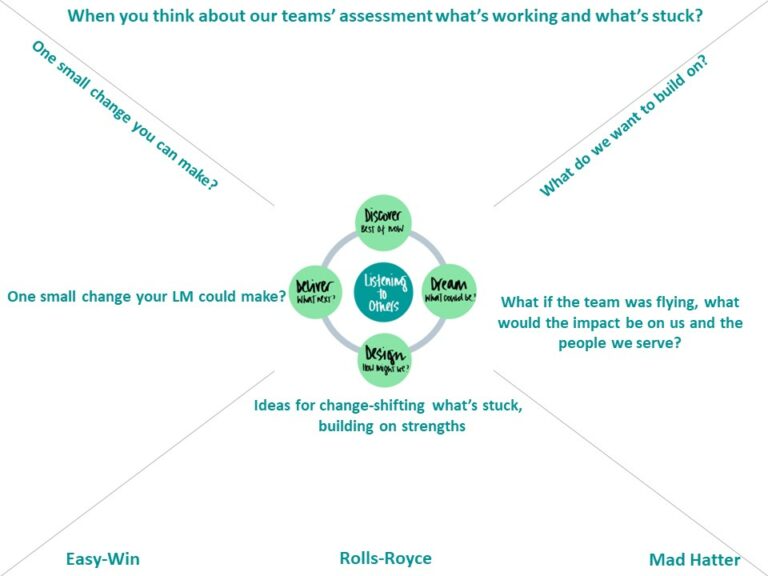
In both the Discovery and Dreaming part of the Appreciative Inquiry, you will be asking Powerful Questions as you undertake a series of Empathy Journeys with others.
The next two sections of the toolbox will take you through this in detail to enable you to have an understanding on which to conduct the practical activity later. Please work your way through this and speak with your Thinking Partner to confirm your understanding.
Detailed Guidance for your Mini Appreciative Inquiry
Resource: Detailed Guidance for Appreciative Inquiry