The pace of organisational change and the changing expectations of followers as a result of the pandemic hugely impacts the role of leaders. In this section of the toolbox, we invite you to do some reflection and to create your leadership compass for your journey beyond this programme. Here are two sources to get you thinking, embrace what works for you and disregard what doesn’t.
Watch this video and relate or not to the 6 areas for Future Leadership.
Personal Leadership Compass
The final formal task of the programme is to create your Personal Leadership Compass for the future. This compass is a creative image, and we ask that you don’t use PowerPoint. Please engage with your creative side.
Creativity
A recent IBM study of more than 1500 CEOs reports that the single most important leadership competency for leaders in the complex systems of today and tomorrow is creativity. They also discovered that many leaders are insecure around the idea of creativity, believing that they are not the creative type.
My experience is that this thinking can be unblocked, and enabling leaders to do so can have far-reaching implications for them, their organisations, their families, and the wider community.
To begin, leaders need to let go of the internal voice of judgement that says, “I’m not good at this sort of thing”. This is not about being an artist: if you have ever solved a problem, found a way around something, baked a cake or built a sandcastle, then you are creative. Trust the process. What’s the worst thing that can happen?
Guidance
There is no time limit on this. You might make a start and then come back to it; it is your choice.
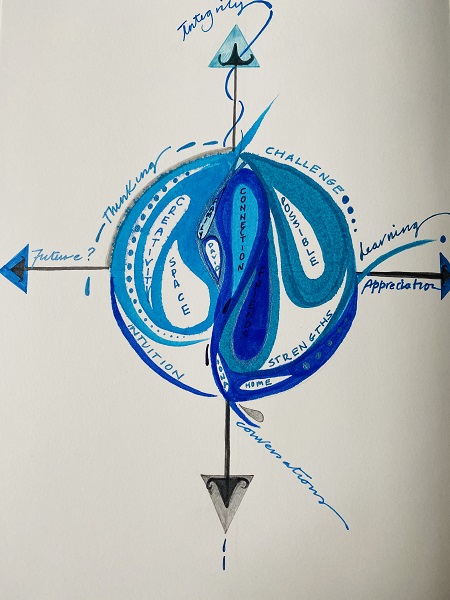
The Leadership Compass is an invitation into a safe, creative space. What follows is guidance, not a process or set of rules, more like some tips and thoughts. I have provided you with my compass and its story on the following pages in the spirit of shared learning, not as an exemplar.
Create your compass in whatever size you like, as long as it can be photographed and read as part of a collective artefact. As a rule of thumb, I would say no smaller than A4.
One leader who loved scrap metal built something, another baked a cake! It’s the making that matters: collage, drawing, sewing, whatever. Just manifest your thinking in a visual way. The only rule is no PowerPoint and no computer-generated images! No one will die! Leadership is about stepping into the unknown…
Questions that could help
- How do you ‘show up’ as a leader in your whole life?
- Who and what keeps you ‘straight’?
- What values guide you?
- What would you like to think your leadership legacy will be?
Overview
When I was thinking about my Leadership Compass, I was thinking about what and who keeps me ‘straight’ on my journey. I see this as a whole life thing, not just how I lead myself and others in a work context but how I ‘show up’ as a leader in all aspects of my life. This is to do with who I am in all relationships and accepting that how I use the compass to navigate these relationships will be different.
The Design
I started with the basic compass shape. The four points of the compass are what I think you will see in my behaviour as a constant. Blue symbolises calm, and the blues I have chosen are reminiscent of the blues I see in the water around the West coast of Scotland. The shapes are more fluid than rigid. I’m not great with too many rules, although I think there is a need for some structure to hold things together.
The Words
Centrally, the words show my connection to David, my family, my friends, and the Island of Iona (maternal heritage). Without these people and places, I would be adrift. They are at the heart of my compass. The other words inside and outside the circle describe what I think I do with my leadership and how I engage others on my and their own leadership journey.
Reality
Of course, none of this means that I don’t make mistakes, get lost on the road, or take a path in spite of the compass: this is the human condition. However, having the compass and sharing it with you gives me a chance to show some of my vulnerability and strengths and provides a framework for self and peer reflection.
Importantly, on this journey, I see you all as my thinking equals: my thinking is not more important than yours, only different.