
CONTEXT
Once you have begun the journey on your own Personal Leadership Development, it’s critical that you have an awareness of two other strong influences on your behaviour and responses. The context within which the organisation functions and how that context impacts you as a leader.
In a Systems Thinking view, the work is to look at the interdependencies and the constant changing of relationships and experiences based on context. Fundamentally, we believe that we can’t untangle the system because the system itself is full of people, and people, by their human nature, are messy. The question is: ‘How do we create learning spaces that enable people to see the unseen in the system and respond in a more connected way?’
The content of this section will support you to be fully present and connect with your deeper purpose, resulting in a cycle of development and change in contrast to becoming caught in a cycle of fear and sacrifice.
Whether the system is a small business, a team or a large organisation, we often spend inordinate amounts of time and energy trying to untangle things and less time thinking about how we can be effective in the complexity.
Hear Fiona introduce the section
Organisational Metaphors
No one can avoid experiencing organisations. From the moment we are born until we die, our lives are governed and constrained by organisations, and almost everyone works in an organisation at some point, albeit some are very small and some very large. However, even if you operate a single-person small business, you will still be part of a larger organisational network of suppliers and customers.
Although we have this all-pervading organisational experience, not very many people think deeply about how the organisational environment of work shapes and constrains the issues leaders have to address. The metaphors we adopt in thinking about organisations shape the way we conceptualise the whole leadership endeavour.
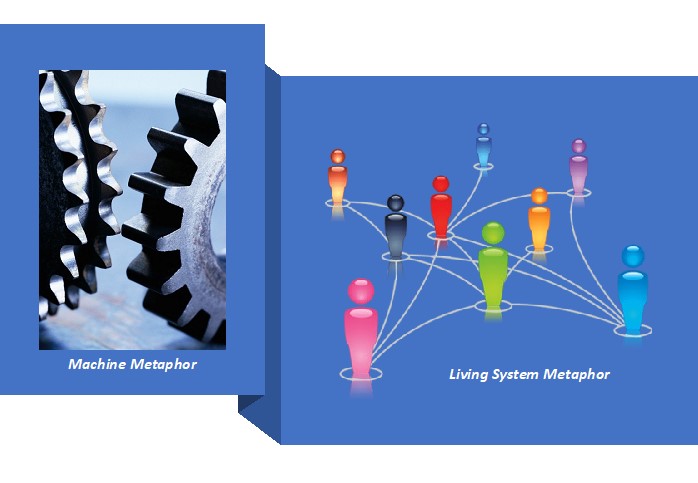
We offer the machine and living systems metaphors to you as a way of viewing the organisation and how it works. Our hope is that this allows you to think differently about organisation structure, process and the behaviour of people. We do not suggest that one is right and the other wrong. What we would like you to ponder is that the overall focus on the machine metaphor has been to the detriment of ways of being that supported civilisations for centuries before the industrial and technological revolutions.
In the wake of the industrial revolution and the beginnings of large-scale manufacturing and production perhaps this was helpful. In the complex ever shifting environment that is the world of work today, the idea of the organisation as a living system with emotions, feelings and the capacity to change, adapt and re-invent is also useful.
Machine Metaphor
This metaphor has proved to be extremely durable and powerful in influencing our understanding of organisations and how people behave in organisational settings. The majority of leaders, managers and individuals, whether they realise it or not, carry this idea of an organisation into every organisational interaction. Many of the principles and underlying assumptions that accompany this metaphor appear to have penetrated every aspect of organisational belief, language and behaviour.
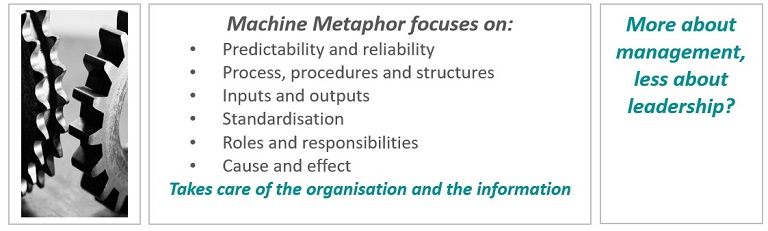
In summary:
- Process before people
- Change is associated with “breakdowns” and malfunctions and things that need to be fixed
- More focus on control and compliance than on ideas, innovation
- People are told what to do, this may well produce compliance, but can contribute to poor morale, avoidance, and absence
- Emotions and emotional displays can be seen as problematic and rarely seen as a legitimate reaction to unpleasant news, or as useful information about an aspect of the change that may have been overlooked
- There is an inherent suggestion in this way of thinking that there will be a right answer to the question, problem, or situation
Living Systems Metaphor
An organisation can be viewed as “living” in two distinct ways. Firstly, there is the idea that it is made up of people, so is, therefore, alive. Secondly, there is the idea that joining the people involved creates “the organisation”, which is therefore alive, dynamic and responsive to the environment.
It is interesting to reflect on how communities worked together prior to the industrial and technological evolutions. Whilst we accept and embrace all the good that these changes brought, we also raise the question about what was lost. The concepts of conversation, community and relationship will be a specific part of our focus around the “Living System Metaphor”.
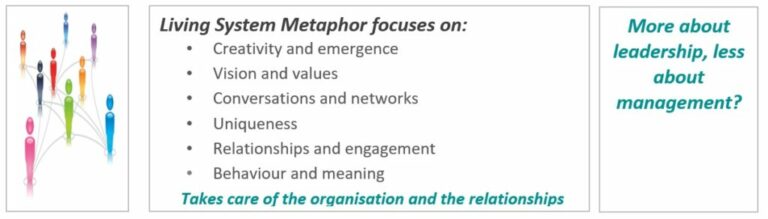
In summary:
- People before process
- Acceptance that where there are people, there will be confusion, misunderstanding, enlightenment, common cause, conflict and harmony
- More focus on strengths, appreciation and potential for growth
- Asking more, telling less
- Whatever I put my energy into grows, both positive and negative
- A belief in the power of positivity
- A belief in the power of conversations
Leader, Manager or Both
It’s likely that you recognise your organisation in both metaphors. The interesting reflection for you in your leadership role is which is dominant and does that push you more to management or to leadership. Most people in organisations that have either title manager or leader do both. The point is to think about balance and really question yourself about where you sit on the leader-manager continuum.
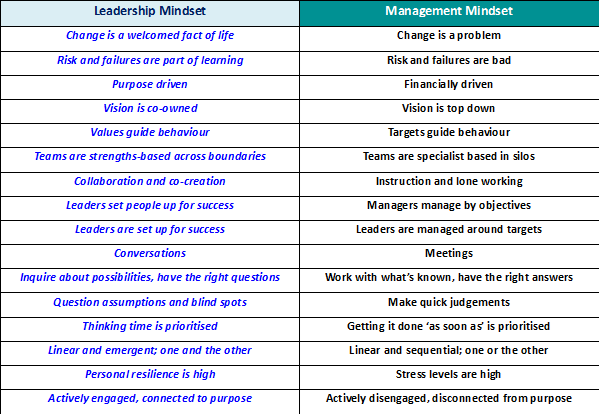
Place in the System
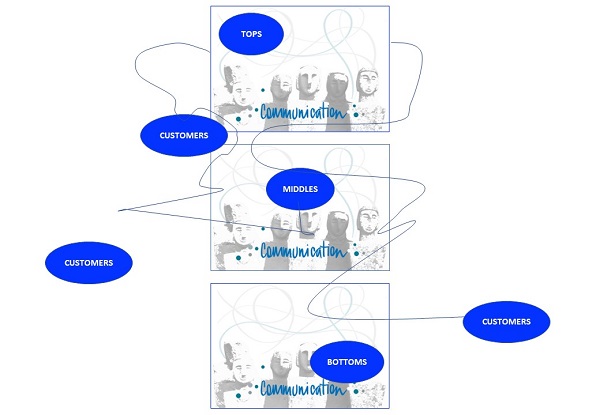
As well as how we see the organisation as a metaphorical construct, how we feel about our place in the system is just as powerful in how we lead. What we say and do or don’t say and don’t do can all be impacted by our ‘feelings’ about ‘our place’ in the system. Barry Oshry talks about Tops, Middles and Bottoms and Customers in his book Seeing Systems, and the fascinating fact that in one situation you may be in any one of these positions.
Take a few minutes to read through this summary of the book and make some notes.
Watch the videos below from Peter Senge on Systems Thinking.
Appreciative Inquiry with Line Manager
Inquiry
“The important thing is not to stop questioning; curiosity has its own reason for existing. Most people waste their time by asking questions that are intended to discover what a pupil does not know, whereas the true art of questioning is to discover what the other does know or is capable of knowing.” – Einstein
Questions are more transformative than answers and are essential tools of engagement. Questions create the space for something new to emerge. However, in the busy world of task, target, fix it and sort it, answers are still valued more than questions and, in the short term, often feel easier. Answers, especially those that respond to our need for quick results, while satisfying, shut down the discussion, and the future shuts down with them.
As leaders, what does this mean for our practice and how we ask questions?
Time has been called on the old-fashioned patterns of questions that many of us have been trained in and trained others to use. The processes we used 10 years ago are not fit for the unprecedented times of uncertainty and austerity that organisations find themselves in. We need to change.
For 10 years, I have explored a variety of models that come at questions from a different perspective. These include Appreciative Inquiry, Thinking Environments and Systems Thinking.
This process of you interviewing your line manager aims to capture your curiosity and support you to join the journey to discover powerful and generative questions – ones that not only change the conversation but also change the future.
Guidance
You will need 30-45 minutes; on no account should this be done on an email. Make sure you get the appointment in place with the line manager as soon as the programme goes live. Be mindful that you are there to inquire into the thinking of your line manager, not the other way around.
It might be good to record the interview if your line manager is willing, which means you can be fully present and not distracted in terms of note-taking. Make sure you are appreciative of their time and that you have a format and a pattern of questions you will be using. Depending on their thinking preferences, they might like to see the questions beforehand.
Afterwards, listen to the recording and pull out what you think are the most important insights for you personally.
Questions
- When you think about my strengths as a leader, what comes to mind?
- What do you see as the benefits of working from a strengths-based perspective?
- In your view, in the context of my leadership, what do I need to let go of, and what do I need to learn?
- If this programme was to help me shift my impact, what would you like to see, and how can you support me?
Remember to end with appreciation and let your line manager know that you may come back with further inquiry as the programme progresses.
Finally, make some notes about what you have learned as a result of the process, the conversation and the impact moving forward.