

A positive way of being and leading has been proven not only to impact well-being but also business results. This section in the toolbox invites you to consider the impacts of choosing to focus on what’s possible, what we can do, how we might do it and to engage with our strengths and those of our team.
The following is an excerpt from the work of Martin Seligman:
What is Positive Psychology: A Definition
Positive psychology has been described in many ways and with many words, but the commonly accepted definition of the field is this:
“Positive psychology is the scientific study of what makes life most worth living” (Peterson, 2008).
To push this brief description a bit further, positive psychology is a scientific approach to studying human thoughts, feelings, and behaviour, with a focus on strengths instead of weaknesses, building the good in life instead of repairing the bad, and taking the lives of average people up to “great” instead of focusing solely on moving those who are struggling up to “normal” (Peterson, 2008).
Positive psychology focuses on the positive events and influences in life, including:
- Positive experiences (like happiness, joy, inspiration, and love)
- Positive states and traits (like gratitude, resilience, and compassion)
- Positive institutions (applying positive principles within entire organizations and institutions)
As a field, positive psychology spends much of its time thinking about topics like character strengths, optimism, life satisfaction, happiness, well-being, gratitude, compassion (as well as self-compassion), self-esteem and self-confidence, hope, and elevation.
At the core of sustaining what you have discovered about your personal leadership and what you want to change is the concept of functioning from a strengths-based perspective. This focuses on your natural skills and talents and invites you to think about what you can do and what is possible.
- Strengths-based approaches value the capacity, skills, knowledge, connections and potential of individuals
- Focusing on strengths does not mean ignoring challenges or spinning challenges into strengths
- Thinking and behaving in this way, we have to work in collaboration – helping people to do things for themselves and doing what we do best
- The strengths approach to work has broad applicability, and research shows it improves motivation, belonging, well-being and performance
Identifying Your Strengths
Depending on which programme you are undertaking, you will be guided to one of two textbooks where you will read through the text and then complete an online self-assessment to identify your top 5 leadership strengths.
Both of these books have been published by Gallup who have spent over 30 years identifying the link between strengths, performance and well-being.
Patterns of Strengths
There is an opportunity to purchase the book for the team that you lead and identify the patterns of strengths across the four domains.
- Executing: People with strengths in this key domain know how to rally around a goal and get things done. Differing strengths might dictate the style of getting to the goal, but people who have strengths in this area make a massive contribution to things happening.
- Influencing: People with strengths in this key domain know how to share and embed the team’s ideas both inside and outside the organisation. These people are natural persuaders, inspire others to adopt their ideas and are vital to moving teams forward in communities.
- Relationship Building: Those with strengths in this domain tend to keep groups together. They’re the social glue: the mortar between the foundation building blocks. They know how to create and maintain groups such that the whole is much greater than its parts.
- Strategic Thinking: People with strengths in this domain tend to force the group to look at the big picture and toward the future – what might be. Always reviewing the data and applying what they learn, strategic thinkers move the organisation forward – stretching its members to think beyond what is and what are the possibilities of the future.
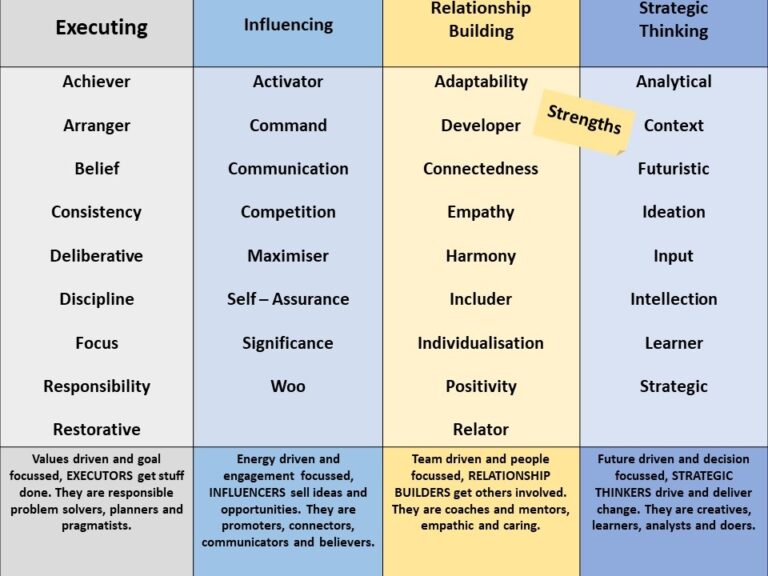
Resource: Strengths-Based Leadership
Guidance
- Download and print both resources
- Note your top 5 strengths on the Stengths Map
- Read and highlight relevant areas on Strengths and Impacts
- Arrange a 1-to-1 with your Line Manager to discuss what you have found out